

What are the benefits of reactive power compensation?
Using capacitors to improve the power factor is a must, and in fact, design units and cabinet installation companies do it as a habit. They can list the benefits of reactive power compensation, but few people know that capacitors are not effective in all cases. The following article will specifically present the benefits of compensation along with specific application conditions.
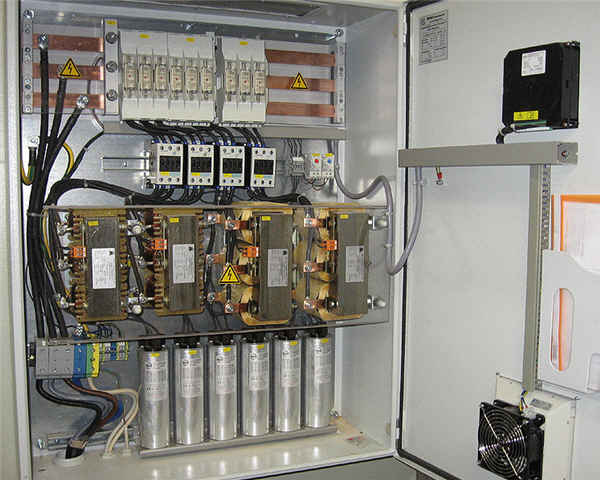
REACTIVE POWER COMPENSATION HELPS REDUCE FINES
Fines are also known as reactive power purchase fees. This is the most practical benefit of improving the Cos phi power factor.
When does compensation help reduce fines?
The answer is when you have to pay a cos phi fine (reactive power purchase fee) every month. The electricity company will make you pay for reactive power when your Cos phi power factor is < 0.85. You can refer to the article Reactive power purchase price to know more about the penalty rate. For example, you have a 100kW electrical device, Cos phi = 0.80, running 10 hours a day. We will have the following data: Electricity used in 1 hour: 100kW * 1h = 100kWh Electricity used in 1 day (10 hours): 100kW * 10h = 1,000kWh Electricity used in 30 days: 1,000kWh * 30 days = 30,000kWh Rate of paying extra for reactive electricity: 6.25% According to regulations Suppose you use electricity for production and only use it during normal times. According to the electricity price list from July 1, 2012: Cost of purchasing active electricity: 30,000kWh * 1,278 VND/kWh = 38,340,000VND Cost of purchasing reactive electricity: 38,340,000VND * 6.25% = 2,396,250VND Thus, if you calculate the compensation appropriately, you can “avoid” the monthly fine of about 2,400,000VND. If you compensate, you will counter-invest the cost. Because in this example I only have 1 electrical device, so I just need to buy a compensation capacitor and compensate directly to the electrical device. To increase from Cos 0.8 => 0.9 in the above example, we need 25kVar. The current investment price is about 1,000,000VND. Thus, in just 1/2 month we will have recovered the capital.
REACTIVE POWER COMPENSATION REDUCES POWER LOSS
From the power loss on the transmission line:
transmission power loss
We see that the power loss is created by 2 components. The component due to active power cannot be reduced, but the component due to reactive power can be completely reduced. The result is that reducing power loss leads to reducing power loss. Simply put, reducing electricity bills. So when does this case come into play? When our line is too far away. The state meter is calculated at the station head. In this case, we should compensate almost 0.95 to reduce power loss
COMPENSATION FOR REACTIVE POWER TO REDUCE VOLTAGE DROP
From the voltage loss on the transmission line:
Line voltage loss
We see that the voltage loss is caused by 2 components. The component due to active power cannot be reduced, but the component due to reactive power can be completely reduced. So when does this case come into play? When our line is pulled too far, the voltage at the end of the line drops a lot, causing the motor to not start, get hot, and burn easily. In this case, you should compensate to 0.98 or 1. If you have ever used a pump at the end of this source, you will understand how important it is to have a few extra volts of voltage
REACTIVE POWER COMPENSATION HELPS INCREASE THE LOAD-CARRYING CAPACITY OF THE LINE
The current running on the line consists of 2 components: active and reactive. If we compensate at the end of the line, the reactive current will decrease. So we can allow the line to carry more active current, it’s that simple
REACTIVE POWER COMPENSATION HELPS INCREASE TRANSFORMER CAPACITY
From S=U*I, we see that the transformer capacity consists of 2 parts P and Q. If we compensate well, S is almost equal to P => increases the capacity